
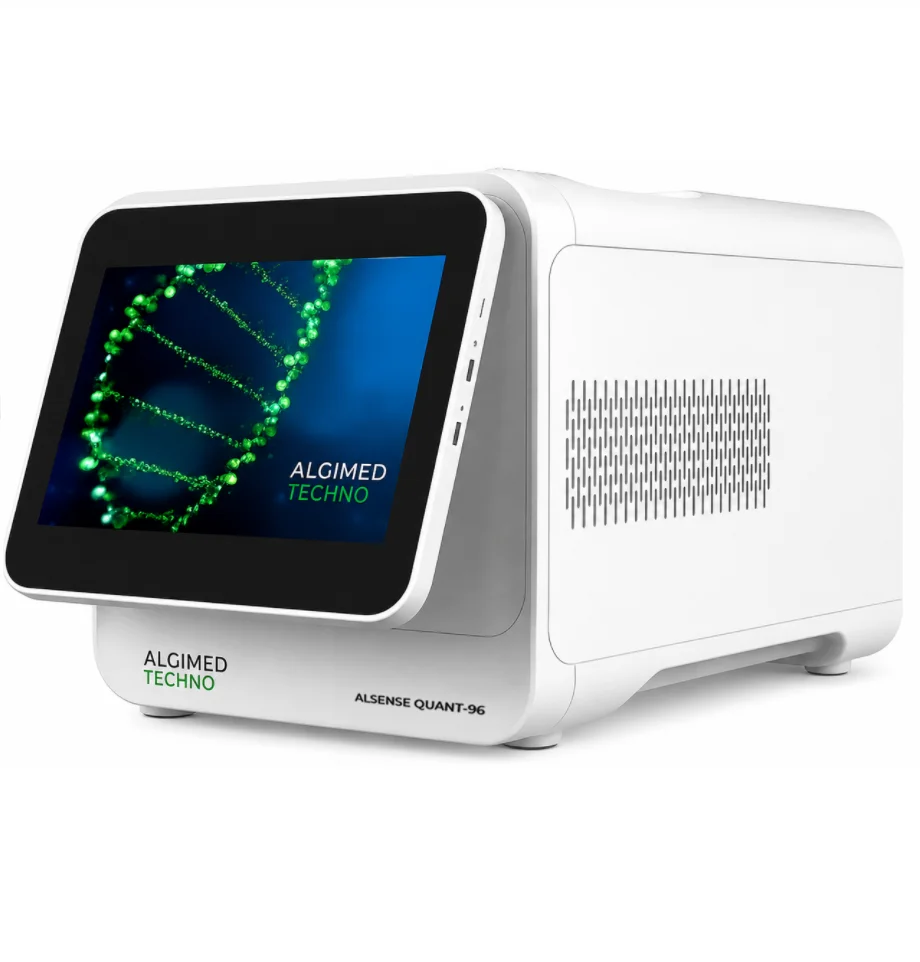
Description
PURPOSE
The ALSENSE Quant-96 is a real-time PCR system designed for the quantitative and qualitative analysis of nucleic acids. The instrument is equipped with a 96-well thermal block, 6 independent fluorescence detection channels, and a fiber-optic detection system. Utilizing Peltier-based thermoelectric cooling and multi-zone independent temperature control, the system achieves heating rates up to 8 °C/s with a temperature accuracy of ±0.1 °C. The built-in 12.1-inch touchscreen display allows users to run protocols and analyze data without connecting to a PC.
The system is applied for:
- Detection of target fragments in test samples;
- Precise quantification of target nucleic acids (viral load, gene expression, GMO analysis) in the source material;
- Genetic identification, High-Resolution Melting (HRM) analysis, and genotyping.
The primary application areas include clinical diagnostics (in vitro), veterinary control, scientific research, forensics, and food safety monitoring. The instrument supports standard 96-well PCR plates, individual 0.2 ml tubes, and 8-tube strips.
PRINCIPLE OF THE METHOD
The system operates based on PCR method with real-time signal detection.
1 Amplification: The reaction module (thermal block) performs cyclic temperature changes for denaturation, annealing, and extension. A unique constant current power supply and multi-zone temperature control ensure identical conditions across all 96 wells.
2 Detection: The optical module monitors product accumulation. Light from a high-power white LED passes through fiber-optic light guides to the wells, while the fluorescent signal from dyes (FAM, HEX, ROX, CY5, etc.) is captured by a high-sensitivity photoelectric detector.
3 Analysis: The software generates real-time amplification curves, calculates threshold cycles (Ct), and interprets results (positive/negative, quantitative calculation via a standard curve).
TECHNICAL CHARACTERISTICS
| Parameter | Value |
|---|---|
| Compatibility | 0.2 ml 96-well plate, tubes, 8-tube strips (transparent) |
| Volume | 10–200 μl |
| Number of channels | 6 |
| Excitation wavelength | 300–810 nm |
| Detection wavelength | 500–810 nm |
| Channel parameters | F1: FAM/SYBR-Green/EVA-Green F2: HEX/VIC/JOE/TET/YELLOW F3: ROX, TEXAS RED F4: CY5 F5: CY5.5 F6: User-defined, default — CY3/TAMRA |
| Linear range | 101-1010 copies/μl |
| Limit of detection | 1 copy |
| Excitation light source | High-power white LED |
| Detector | High-sensitivity photoelectric detector |
| Optical stability and calibration | Maximum detectable RFU value: 65,535. Calibration: manual FLR CO setting (deviation ≤ ±500 RFU). Acceptance criterion: signal deviation of each channel after all cycles must not exceed ±500 RFU from the initial calibrated value |
| Ct repeatability | CV ≤ 1% |
| Linearity (Ct) | |r| ≥ 0.999 |
| Temperature range | 0–105 °C |
| Temperature control mode | Block control / Tube reagent control |
| Average heating rate | 3.5 °C/s |
| Average cooling rate | 2.5 °C/s |
| Maximum heating rate | 8 °C/s |
| Maximum cooling rate | 8 °C/s |
| Temperature uniformity | ±0.2 °C at 95 °C |
| Temperature accuracy | ±0.1 °C |
| Temperature setting accuracy | 0.1 °C |
| Melting temperature | Minimum temperature difference: 0.1 °C |
| Gradient mode | 6-gradient temperature control |
| Gradient temperature range | 0.1–42 °C |
| Lid heating temperature | 30–115 °C |
| Display screen | 12.1-inch color touchscreen |
| Dimensions (W×D×H) | 350 mm × 520 mm × 330 mm |
| Weight of main units with detection system | 32 kg |
| Power supply | 100–240 V, 50–60 Hz |
| External interfaces | USB 2.0 × 2, RS232 × 1 |
| Wireless connectivity | Expandable wireless data transmission. Support for LIS integration |
| Data export formats | Excel, PDF, TXT, CSV, JPG |
ADVANTAGES
- Performance: 6 detection channels for multiplexing.
- Accuracy: excellent repeatability (CV ≤ 1%) and sensitivity (1 copy) ensure reliable quantitative results.
- Speed: ultra-fast cycling (up to 8.0 °C/s).
- Efficiency: 96-well scanning in 5 seconds significantly reduces run times.
- Reliability: maintenance-free LED source.
- Flexibility: 6-zone temperature gradient (up to 42 °C) for rapid assay optimization.
- Stand-alone operation: via a 12.1″ touchscreen.
- Data stability: intelligent auto-calibration ensures signal stability.
- Connectivity: built-in LIS integration and data export to Excel, PDF, TXT, CSV, JPG.
- Powerful software: qualitative/quantitative analysis, HRM, genotyping, and relative quantification in a single interface.


